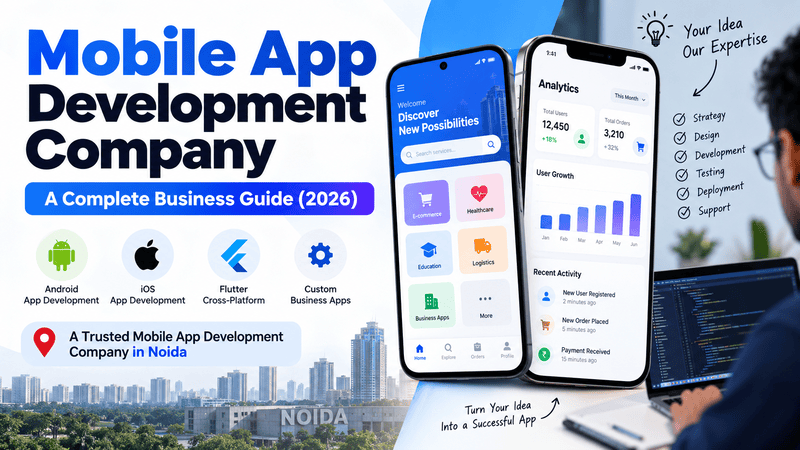
Mobile applications have become an important part of how businesses connect with customers, manage operations and deliver services. From e-commerce and healthcare to education, logistics and real estate, companies are investing in mobile technology to improve customer experience and streamline their business processes.
Mobile App Development Company: How to Choose the Right Partner for Your Business
Mobile applications have become an important part of how businesses connect with customers, manage operations and deliver services. From e-commerce and healthcare to education, logistics and real estate, companies are investing in mobile technology to improve customer experience and streamline their business processes.
However, building a successful mobile application requires more than writing code. Businesses need the right strategy, user-friendly design, reliable technology, proper testing and ongoing support.
Choosing the right mobile app development company can help transform your idea into a practical digital solution that aligns with your business goals.
Whether you are a startup planning your first application or an established business looking to digitise your operations, understanding the development process will help you make informed decisions.
What Does a Mobile App Development Company Do?
A mobile app development company helps businesses plan, design, develop, test and launch applications for smartphones and tablets. Depending on the project requirements, the company may also provide backend development, API integration, cloud deployment and post-launch maintenance.
Professional mobile app development services typically include:
-
App strategy and planning: Defining business objectives, target users and essential features.
-
UI/UX design: Creating intuitive interfaces and user journeys.
-
Android app development: Building applications for Android smartphones and tablets.
-
iOS app development: Developing applications for Apple devices.
-
Cross-platform app development: Creating applications for multiple platforms using technologies such as Flutter.
-
Backend and API development: Managing databases, authentication, business logic and third-party integrations.
-
Testing and deployment: Checking functionality, performance, security and compatibility before launch.
-
Maintenance and upgrades: Updating features, fixing issues and supporting the application after release.
A complete development approach ensures that your application is designed around actual business requirements rather than unnecessary features.
Types of Mobile Applications Businesses Can Develop
The right application depends on your business model, audience and objectives. Before hiring a mobile app development company, identify the type of solution you need.
1. E-commerce Mobile Applications
E-commerce applications allow customers to browse products, place orders, make payments and track deliveries from their smartphones.
Common features include product catalogues, search filters, shopping carts, payment gateway integration, order tracking, push notifications and customer accounts.
These applications are useful for retailers, direct-to-consumer brands and online marketplaces looking to improve the mobile shopping experience.
2. Healthcare and Appointment Booking Applications
Healthcare applications can simplify appointment scheduling, patient communication and access to services.
Depending on the requirements, they may include doctor profiles, appointment calendars, notifications, patient dashboards and secure information management.
Businesses developing healthcare applications should also consider applicable privacy, security and regulatory requirements.
3. Education and E-Learning Applications
Educational applications help institutions, training providers and businesses deliver learning content through mobile devices.
Popular features include video lessons, quizzes, course management, progress tracking, discussion forums and online workshops.
4. Logistics and Delivery Applications
Logistics applications help businesses manage shipments, assign delivery personnel and track operational activities.
Features may include shipment booking, digital proof of delivery, location tracking, status updates, document uploads and admin dashboards.
5. Custom Business Applications
Some businesses require applications designed around their internal processes rather than a standard consumer-facing model.
Examples include employee management applications, CRM systems, field sales applications, inventory management tools and customer service platforms.
A custom mobile application can help reduce manual work, improve coordination and provide better visibility into business operations.
How to Choose the Right Mobile App Development Company
Selecting a development partner is an important decision because the quality of planning and implementation can influence your application's performance, maintainability and future development costs.
Consider the following factors before making your decision.
1. Understand Your Business Requirements
Before comparing development companies, define what you want your application to achieve.
Identify your target audience, key business problem, essential features and expected outcomes. A clear project brief helps developers estimate the scope, timeline and budget more accurately.
2. Review Their Portfolio and Experience
Examine previous projects to understand the company's development capabilities.
Look for experience with applications similar to yours, relevant industries, complex integrations and the type of functionality your project requires.
You can explore the InWeb Technologies project portfolio to review examples of web and mobile application projects.
3. Evaluate Their Technology Expertise
The right technology depends on your application requirements, expected traffic, integrations and long-term roadmap.
A development partner should be able to explain the advantages and limitations of the proposed technology rather than recommending a particular framework for every project.
4. Ask About UI/UX and Testing
An application may have all the required features but still perform poorly if its interface is confusing or its functionality is unreliable.
Ask how the company handles wireframes, interface design, device compatibility, functional testing, performance testing and security checks.
5. Understand the Complete Project Cost
Do not compare quotations based on price alone. Check whether the proposed cost includes design, frontend and backend development, integrations, testing, deployment and documentation.
You should also clarify recurring expenses such as hosting, third-party APIs, maintenance and app store accounts.
6. Check Post-Launch Support
App development does not end when an application is published. Operating systems change, users report issues and businesses introduce new requirements.
Choose a development partner that clearly defines its warranty or initial support period, maintenance terms and process for future enhancements.
Android vs iOS vs Cross-Platform App Development
One of the first technical decisions is choosing which platforms your application should support.
Android App Development
Android development is suitable for businesses targeting users across a broad range of smartphone manufacturers and device categories.
Native Android applications can be developed using technologies such as Kotlin, depending on the project requirements.
iOS App Development
iOS development is appropriate for businesses targeting iPhone and other supported Apple devices.
Native iOS development commonly uses Swift and Apple's development tools.
Cross-Platform App Development
Cross-platform frameworks such as Flutter allow businesses to build applications for Android and iOS using a shared codebase for much of the application.
This approach can reduce duplicated development work, although platform-specific functionality and additional engineering may still be required.
The right choice depends on your budget, performance requirements, target audience and product roadmap.
For businesses looking to evaluate these options, explore InWeb Technologies' app development solutions.
What Is the Cost of Mobile App Development in India?
The cost of developing a mobile application varies according to its complexity, features, technology, integrations and maintenance requirements.
A simple business application with basic functionality will generally require less investment than a marketplace, delivery platform or enterprise application with multiple user roles and complex workflows.
The following factors commonly influence the development budget:
-
Number of screens and user journeys.
-
UI/UX design requirements.
-
Android, iOS or cross-platform development.
-
Backend architecture, database and admin panel.
-
Payment gateways, maps, messaging and other API integrations.
-
Security, testing and performance requirements.
-
Deployment, hosting and ongoing maintenance.
For an accurate estimate, prepare a list of essential features and discuss your requirements with a development team before finalising the budget.
You can also review the InWeb Technologies pricing and plans page for available starting prices and quotation options.
Why Choose a Mobile App Development Company in Noida?
Businesses in Noida, Greater Noida and Delhi NCR can benefit from working with a development team that is accessible for discussions, requirement analysis and project coordination.
A local development partner can make it easier to organise meetings, review prototypes, discuss changes and coordinate with internal teams when required.
However, location should not be the only deciding factor. Technical expertise, communication, development processes and long-term support are equally important.
Mobile App Development Company in Noida for Startups and Growing Businesses
If you are searching for a mobile app development company in Noida, look for a team that understands both the technical and commercial aspects of your project.
Startups may need an MVP to validate their business idea, while established companies may require customer applications, operational tools or integrations with existing systems.
InWeb Technologies is a Noida-based IT company providing mobile application development alongside web development, backend systems and digital solutions.
Our team works with technologies such as Flutter, Node.js and database-driven backend systems to develop applications around specific business requirements.
From initial planning and UI/UX to development, testing and deployment, the focus is on building practical solutions that support business objectives.
Explore our mobile app development solutions to discuss your application requirements.
Our Mobile App Development Process
A structured development process helps businesses manage scope, reduce uncertainty and prepare for future improvements.
Step 1: Requirement Analysis
We understand your business model, target audience, core functionality and project objectives.
Step 2: Planning and UI/UX Design
The user journeys, application structure and interface designs are prepared before the main development work begins.
Step 3: Application Development
The frontend, backend, database and required integrations are developed according to the agreed scope.
Step 4: Testing and Quality Assurance
The application is tested for functionality, compatibility, performance and common usability issues.
Step 5: Deployment and Launch
The application is prepared for release on the relevant platforms, subject to their submission and approval requirements.
Step 6: Maintenance and Improvements
After launch, the application can be updated to fix issues, improve functionality and support changing business requirements.
Common Mistakes to Avoid When Developing a Mobile App
Businesses can improve their chances of success by avoiding a few common mistakes.
Building too many features initially: Prioritise essential functionality and consider releasing an MVP before investing in advanced features.
Ignoring the user experience: Make important tasks easy to complete and keep navigation straightforward.
Choosing technology based only on price: Consider scalability, maintenance, integrations and long-term development requirements.
Underestimating ongoing expenses: Account for hosting, third-party services, security updates and maintenance.
Skipping testing: Test critical user journeys before release to reduce avoidable problems.
Not planning for growth: Consider future users, data volumes, integrations and feature expansion when designing the architecture.
A well-planned application focuses on solving a genuine problem and delivering a reliable experience rather than simply offering a long list of features.
Conclusion
Choosing the right mobile app development company is an important step towards turning your business idea into a reliable digital product.
From selecting the right technology to defining the features, planning the budget and preparing for future maintenance, every stage contributes to the application's long-term value.
Whether you need an Android application, an iOS app, a cross-platform solution or a custom business application, begin with clear requirements and choose a development partner that understands your objectives.
InWeb Technologies works with businesses to plan and develop mobile applications aligned with their operational needs and growth plans.
Have an app idea? Contact InWeb Technologies to discuss your requirements and explore a suitable development approach.
Frequently Asked Questions (FAQs)
1. What does a mobile app development company do?
A mobile app development company plans, designs, develops, tests and deploys applications for mobile devices. Depending on the project, services may also include backend development, API integration, database management, deployment and ongoing maintenance.
2. How much does mobile app development cost in India?
Mobile app development costs depend on the number of features, platform requirements, design complexity, backend functionality and integrations. A basic business application generally costs less than a complex marketplace or enterprise solution. A detailed quotation requires an understanding of the project scope.
3. How long does it take to develop a mobile application?
The timeline depends on the application's complexity, number of platforms, design requirements and integrations. A simple MVP may take several weeks, while a complex application can require several months or longer. The timeline should be established after requirement analysis.
4. Which technology is best for mobile app development?
There is no single best technology for every application. Flutter can be suitable for cross-platform projects, while native technologies such as Kotlin and Swift may be appropriate when platform-specific capabilities are important. The choice should reflect the product requirements and long-term roadmap.
5. Should I hire an Android app development company or an iOS app development company?
Choose based on your target audience, business model and launch strategy. If you need to reach both Android and iOS users, consider native development for both platforms or a cross-platform framework such as Flutter.
6. How do I choose a mobile app development company in Noida?
Review the company's portfolio, technical expertise, project management process, testing practices, pricing transparency and post-launch support. Discuss your requirements in detail and request a clear scope of work before signing the agreement.
7. Can a mobile app development company build a custom business application?
Yes. A development company can build applications for inventory management, employee coordination, customer management, logistics, bookings, e-commerce and other business processes. Features and integrations are selected according to the organisation's requirements.
8. Does mobile app development include backend and API integration?
It can. Depending on the agreed scope, development may include backend services, databases, authentication, admin dashboards and integrations with payment gateways, maps, messaging services or other external systems. Confirm which components are included in the quotation.
9. Do I need maintenance after launching my mobile application?
Yes, ongoing maintenance is generally recommended. It may include bug fixes, compatibility updates, security improvements, performance monitoring and feature enhancements. The maintenance scope and charges should be agreed upon separately or included in the project contract.
10. How can I get a quotation for mobile app development?
Prepare a brief describing your business idea, target users, essential features, preferred platforms and any required integrations. Share these details with InWeb Technologies to discuss your project and request a quotation.