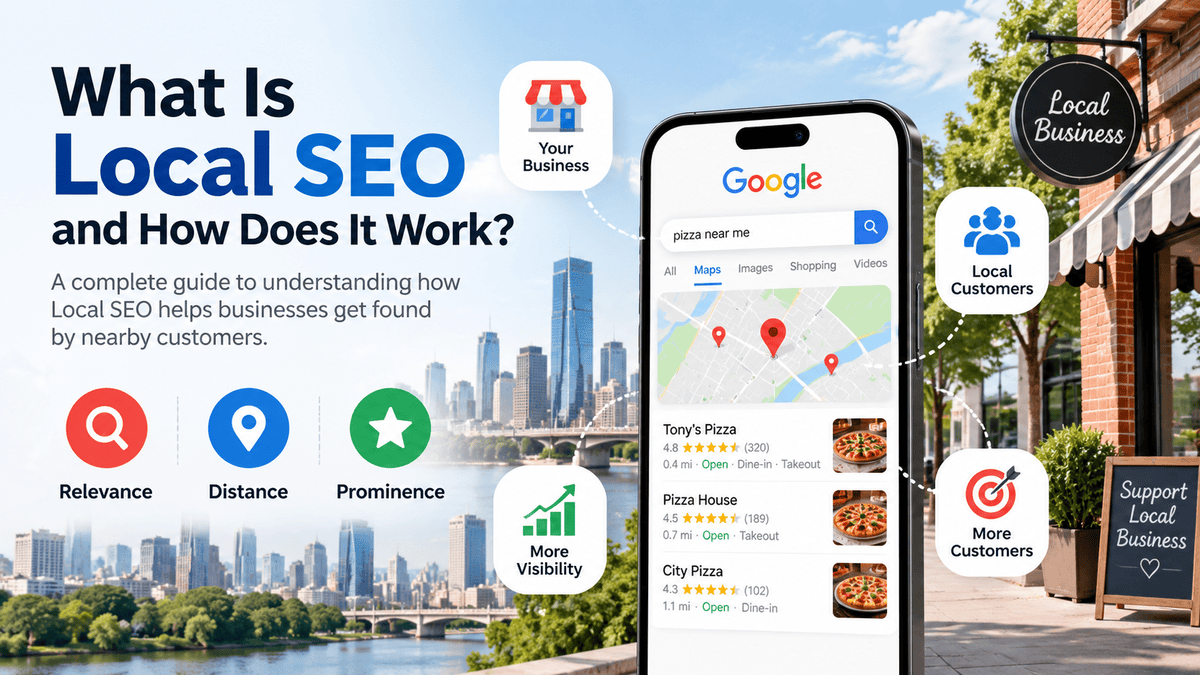
Local SEO, or local search engine optimization, is the process of improving a business's online presence so that it can appear more prominently when people search for products or services in a specific geographic area.
What Is Local SEO and How Does It Work?
If you own a local business, being visible when people search for your products or services online can make a major difference to your growth. A customer looking for a plumber, dentist, restaurant, law firm, marketing agency, or home service provider will often search Google before making a decision.
This is where Local SEO comes in.
Local SEO, or local search engine optimization, is the process of improving a business's online presence so that it can appear more prominently when people search for products or services in a specific geographic area.
For example, someone might search:
Local SEO helps businesses become more visible for searches like these and connect with customers who are actively looking for their services.
What Is Local SEO?
Local SEO is a branch of search engine optimization focused on improving a business's visibility in geographically relevant searches.
Traditional SEO generally focuses on helping a website rank for searches regardless of where the searcher is located. Local SEO adds another important dimension: location.
For example, a traditional SEO strategy might target:
"SEO services"
A local SEO strategy could target:
"SEO services in Houston"
or:
"SEO company near me"
The objective is to help Google understand three important things:
-
What your business does
-
Where your business operates
-
Why your business should be considered trustworthy and relevant
Google states that local search rankings are mainly based on relevance, distance, and prominence.
How Does Local SEO Work?
Local SEO works by sending consistent and useful signals about your business to search engines and potential customers.
These signals can come from your Google Business Profile, website, customer reviews, online business directories, local content, links from other websites, and other parts of your online presence.
When someone performs a location-based search, Google determines which businesses are the most relevant to that particular search.
For example, if someone searches:
"SEO company in Los Angeles"
Google may consider businesses based on how closely their services match the search, their geographic relationship to the searcher, and their overall prominence.
This is why simply adding a city name to a website is not enough to build a successful local SEO strategy.
The Three Main Local SEO Ranking Factors
1. Relevance
Relevance refers to how well a business matches what someone is searching for.
If someone searches for "local SEO services," Google needs to determine which businesses actually provide local SEO services.
Your website and Business Profile should clearly explain:
-
What services you provide
-
Which industries you serve
-
Which locations you serve
-
What makes your business relevant to the customer's search
Complete and accurate business information can help Google better understand your business and match it with relevant searches.
2. Distance
Distance is another important factor in local search.
Google considers how far a business is from the person performing the search or from the location specified in the search.
For example, a search for:
"coffee shop near me"
will produce different results depending on where the person is searching from.
This also explains why two people searching for the same local business category may see different results.
You cannot completely control distance. However, you can make sure that Google has accurate information about your business location and service area.
3. Prominence
Prominence refers to how well-known and established a business is.
Google explains that prominence can be influenced by information such as websites linking to the business and the number of reviews it has.
This is one reason why a strong local SEO strategy should go beyond simply creating a Google Business Profile.
A business may need to build its reputation through:
-
Genuine customer reviews
-
Relevant local links
-
High-quality website content
-
Business listings
-
Mentions from reputable websites
-
Helpful information about its services
Google Business Profile and Local SEO
One of the most important components of local SEO is a Google Business Profile.
A Business Profile allows eligible businesses to manage information that can appear across Google Search and Google Maps, including business details, hours, photos, website information, and customer reviews.
For a local business, the profile should be complete and accurate.
Important information can include:
Businesses should also keep their information updated when details change.
What Is the Google Local Pack?
When you search for a local service on Google, you may see a map followed by a small group of business listings.
This is commonly called the Local Pack or Map Pack.
For example, searching for:
"SEO agency in Miami"
may produce a map and several local businesses before or alongside the traditional organic search results.
Appearing in this section can put a business directly in front of customers who are actively searching for its services.
However, there is no legitimate way to simply pay Google to obtain a better organic local ranking. Google states that local rankings cannot be requested or purchased.
Local SEO Is More Than Google Maps
A common misconception is that local SEO only means optimizing a Google Business Profile.
In reality, a successful local SEO strategy can involve several parts of your online presence.
These may include:
-
Google Business Profile optimization
-
Website SEO
-
Local keyword research
-
Location-specific landing pages
-
Online business directories
-
Local citations
-
Customer reviews
-
Local link building
-
Content marketing
-
Technical SEO
-
LocalBusiness structured data
-
Reputation management
Google also supports LocalBusiness structured data, which can help search engines understand information about a local business such as its business details and operating hours.
Local SEO for Small Businesses
Local SEO can be particularly valuable for small and growing businesses competing against larger companies.
A small business may not have the same advertising budget or brand recognition as a national company. However, it can build visibility for searches related to its specific market and service area.
For example, instead of trying to compete nationally for:
"digital marketing agency"
a business could initially focus on searches such as:
"digital marketing agency in Phoenix"
"SEO company for small businesses in Phoenix"
"local SEO services Phoenix"
This approach allows the business to focus its SEO efforts around a more specific audience.
How to Do Local SEO
A basic local SEO strategy can be divided into several steps.
Step 1: Optimize Your Google Business Profile
Make sure the profile is claimed, verified where applicable, and contains accurate business information.
Choose the most appropriate business category and provide useful information about your services.
Step 2: Optimize Your Website
Your website should clearly communicate what your business does and where it operates.
Important areas can include:
-
Page titles
-
Meta descriptions
-
Headings
-
Service pages
-
Location pages
-
Contact information
-
Internal links
-
Mobile usability
-
Page speed
-
Structured data
Google's documentation also recommends making business information available through your official website and using appropriate structured data to help Google understand your organization.
Step 3: Create Location-Relevant Content
Create useful content that answers questions your local customers actually have.
For example, an HVAC company in Denver could publish:
-
How Much Does HVAC Repair Cost in Denver?
-
How to Prepare Your HVAC System for Denver Winters
-
Common Furnace Problems for Denver Homeowners
The goal should not be to publish dozens of pages with slightly different city names.
Instead, create genuinely useful content that provides value to people in the location you serve.
Step 4: Build Local Citations
A citation is a mention of your business information on another website or directory.
Depending on your business and market, these can include relevant:
Consistency matters. Your core business information should be accurate wherever your business is legitimately listed.
Step 5: Earn Relevant Local Links
Links from other websites can contribute to a site's authority and, according to Google's local ranking guidance, websites linking to a business can be one of the signals associated with prominence.
For local businesses, useful link opportunities can come from:
-
Local news websites
-
Industry publications
-
Business associations
-
Local organizations
-
Community websites
-
Sponsorships
-
Partnerships
-
Local business blogs
-
Relevant resource pages
The quality and relevance of the link matter more than simply obtaining a large number of links.
Step 6: Encourage Genuine Customer Reviews
Reviews are another important part of local visibility and reputation.
Businesses should make it easy for genuine customers to leave feedback and should respond professionally to reviews.
Do not buy fake reviews or create reviews yourself. A sustainable local SEO strategy should be based on genuine customer experiences.
How Long Does Local SEO Take to Work?
Local SEO is not an overnight marketing strategy.
The time required to see meaningful results depends on factors such as:
A business in a smaller market may see progress faster than a business competing in a highly competitive city.
Instead of expecting immediate rankings, businesses should track progress over time using metrics such as:
Common Local SEO Mistakes
Many businesses make the same mistakes when trying to improve their local search visibility.
Creating Fake Location Pages
Creating hundreds of pages that simply replace one city name with another usually does not create useful content.
Location pages should provide genuinely useful information for the people and areas they are intended to serve.
Inconsistent Business Information
Incorrect or outdated business information can create confusion for both customers and search engines.
Keep important business details accurate across your website and legitimate business listings.
Ignoring Reviews
Customer reviews can influence how potential customers perceive a business.
Ignoring reviews means missing an opportunity to build trust and communicate with customers.
Buying Low-Quality Backlinks
Getting hundreds of unrelated backlinks is not a reliable local SEO strategy.
Instead, focus on earning links from websites that are relevant, legitimate, and useful to your audience.
Keyword Stuffing
Repeating phrases such as "best SEO company in New York" dozens of times does not make a page better.
Write naturally and focus on satisfying the searcher's intent.
Local SEO vs. Traditional SEO
Traditional SEO and local SEO share many fundamentals, including:
-
Keyword research
-
Content optimization
-
Technical SEO
-
Internal linking
-
Link building
-
Website performance
The main difference is search intent and geographic relevance.
Traditional SEO might target:
"how to choose an SEO agency"
Local SEO might target:
"SEO agency in San Diego"
Local SEO is especially important when customers are looking for businesses, products, or services in a particular area.
Is Local SEO Worth It?
For businesses that depend on customers from a specific geographic area, local SEO can be an important part of a long-term digital marketing strategy.
People already use search engines to find nearby businesses and services. A strong local presence can help your business appear when those potential customers are looking for what you offer.
The key is to think beyond rankings.
The real objective is to:
Get found → Build trust → Generate inquiries → Convert customers.
Final Thoughts
Local SEO helps businesses improve their visibility when customers search for products and services in a specific geographic area.
It involves much more than adding a city name to a website.
A strong strategy combines an optimized Google Business Profile, useful website content, accurate business information, genuine reviews, relevant local links, technical SEO, and an overall trustworthy online presence.
Google's own guidance identifies relevance, distance, and prominence as the primary factors behind local results.
If your business wants to attract more customers from a specific city, region, or service area, investing in a properly planned local SEO strategy can help build visibility and generate qualified local leads over time.
Looking to improve your local search visibility? Explore our Local SEO Services to see how we can help optimize your business for local search and reach more potential customers.